
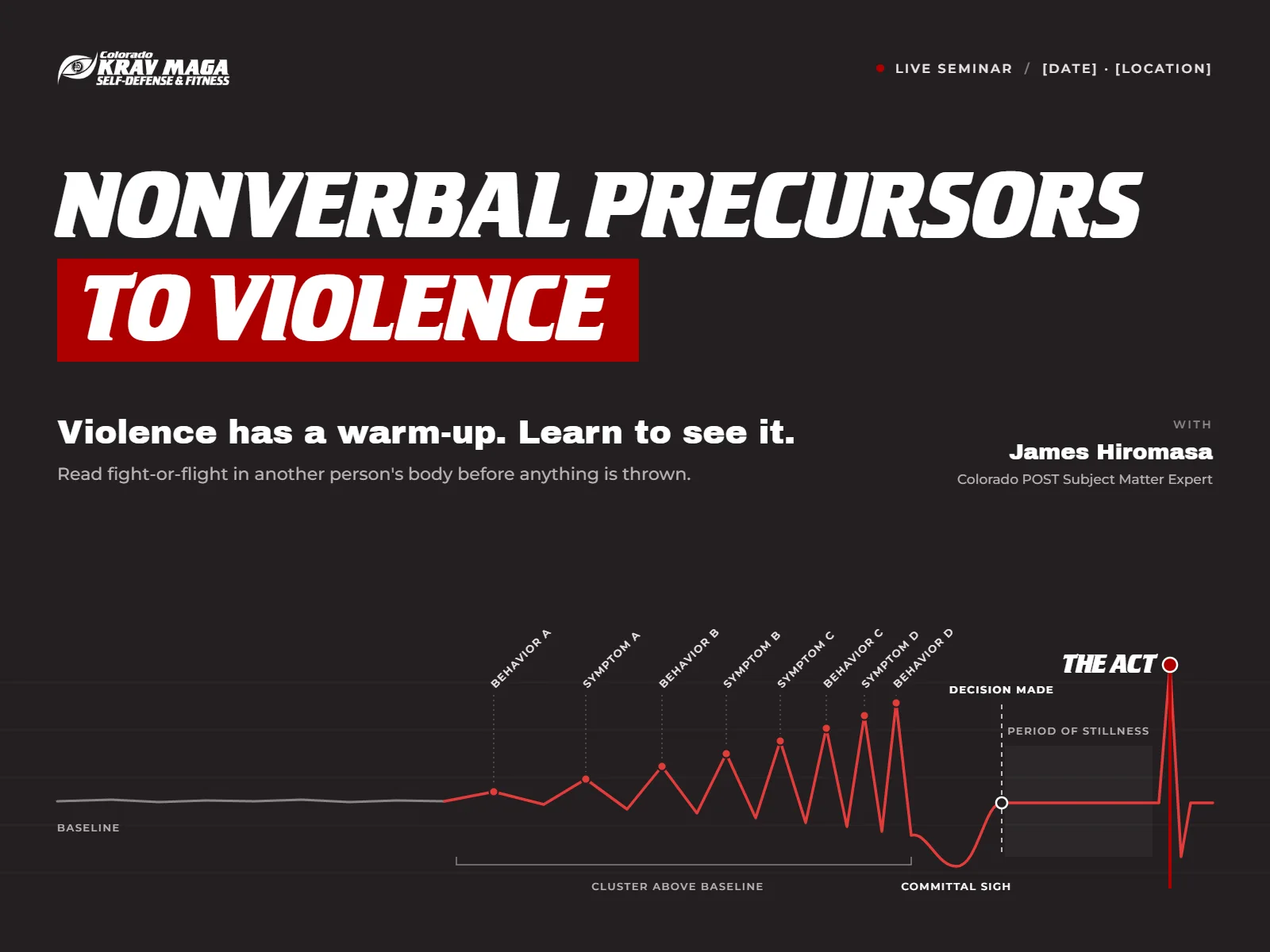
Nonverbal Precursors to Violence: How to Make Real Time Threat Assessments via Body Language (Live Webinar)
$79 $69 per person Sale
Sale price through October 31, 2026
Live online with James Hiromasa, State of Colorado POST Subject Matter Expert, Owner and Co-Founder of Colorado Krav Maga.
Learn to read the physical signs that show up in a person's body before they turn violent. A two-part live seminar on Zoom.
Before somebody decides to hit you, their body has already started getting ready. Cortisol and adrenaline hit the bloodstream, and those are drugs with side effects you can see. Blood leaves the hands. Saliva stops. Hair stands up. He starts stretching muscles he doesn't know he's stretching.
It's physiology, not mind reading, and once you know what to look for you can see it from across a room.
James teaches this seminar to police, code enforcement officers, paramedics and emergency room staff. This time it's open to everyone: people who train, people who teach, and people who've never set foot on a mat.
• Part 1: Friday, November 13 • Part 2: Friday, November 20 • Time: 5:30 PM Mountain (4:30 Pacific, 6:30 Central, 7:30 Eastern) • Format: Two 45-minute sessions, live on Zoom, with the recording of both included
Can't make one of the nights? You get the recording of both parts either way.
It's not "what do I do." It's "when do I do it."
If you train, you have thousands of reps of what to do. That part's handled. If you don't, you've still had the moment where something about a person felt off and you talked yourself out of it.
Either way, the question that causes the delay is the same one.
Good people don't decide to throw the first punch. We give bad actors the benefit of the doubt, over and over, because that's what decent people do. Is this really an attack, or is he just moving his arm? By the time that question settles you're behind the curve, and you're behind it for one reason. You didn't know you were in a fight yet.
That's not a flaw in your training. Every rep you've ever done started when somebody decided it started: a bell, a coach saying GO, a partner feeding the attack you already know is coming. Even good scenario training has a moment where it begins, and everyone in the room knows when that moment is.
Real violence doesn't have a bell.
What the body does before the person decides
When a brain thinks violence might be coming, it signals the glands, and the glands put cortisol and adrenaline into the bloodstream. Powerful drugs, with visible side effects.
Blood pulls out of the hands and into the big muscles. The fingers go stiff and cold, and his hands start working on the problem without him. Digestion shuts down and saliva stops, so he sucks his teeth and takes small sips of a drink he isn't thirsty for. Hair stands up, sweat starts, and everything he's wearing begins to irritate him. The body limbers up on its own: neck, hips, shoulders, chest, back.
He isn't choosing any of it, and mostly he doesn't know he's doing it.
One behavior on its own means nothing. The skill is reading clusters, above a baseline you established first, and that's the difference between this seminar and the cheap body language nonsense on the internet. James demonstrates it live, and the whole seminar is built around real footage.
Once you see it, you can't stop seeing it
James walked into a restaurant with Shannon and some out-of-town friends and paused at the door to scan the room, the way they both always do. Out of sixty or seventy people, his eye kept going back to one man. A few tells on him, but also something else: tells from the people around him. Exclusion behavior. Averted gaze.
He leaned over to Shannon: "Ten minutes before that guy is either in a fight, getting thrown out, or buying everyone drinks."
Ten minutes later the man walked up to their table, chatted for a bit, and bought the table a round.
Shannon: "You called it... and with a timer."
James couldn't predict which of the three it would be, and he doesn't claim to. What he could do was narrow it to three and have a plan ready for each. And Shannon spotted it too, the second he pointed the man out. That's the part that matters for you, because it means this is a skill you can learn, not a gift you're born with.
"James has an incredible way of putting you at ease, while simultaneously opening your eyes to things you never noticed before... James doesn't just present information. He teaches you how to see things differently." - Wholistic I., on this seminar
If you've never trained a day in your life
You don't need to. Your brain already runs half of this for you. That "something's off about that guy" feeling is your subconscious picking up these exact signals and flagging them. What it can't do is tell you what it saw, so most people explain it away.
This seminar is the other half. You'll know what your gut noticed, which means you can trust it early and step away early, long before physical skills ever come into it. Be prepared, not paranoid.
If you teach
This isn't a replacement for anything in your curriculum, it's the glue between awareness and action. You'll leave with a way to tie awareness and preparedness to action, the vocabulary for it, and the reasoning under each piece, which is what you need to answer your students' follow-up questions. James has spent years training instructors to weave this material into any defensive tactics system.
About the footage
It's real: interrogation rooms, a traffic stop, a shoplifter, a news interview. You get the context before each clip, what to look for, and why. It's chosen to teach, not to shock.
"He uses videos and examples that make his points, but are not too gory or scary... He takes you right to the edge to teach the idea or skill, but not enough to make people shut down." - Terry S., after James trained 85 code enforcement officers from Colorado and Wyoming
Two parts, one week apart
- Part 1, Friday, November 13: What the body does. Cortisol and adrenaline hit the bloodstream and cause symptoms the person tries to relieve without knowing it. Those relief behaviors are the tells. You'll also learn how to set a baseline so they mean something.
- Part 2, Friday, November 20: What the brain decides. While the body gets ready, the subconscious works out a plan: fight, flee or comply. Exit glances, target glances, numb face and the committal sigh are what that planning looks like from the outside. You'll also learn how to spot someone carrying a concealed weapon, and the signs they're getting ready to reach for it.
The week in between is the point. Expect to spend it noticing things in the grocery store line you'd never have seen before Part 1, and bring them to Part 2. Each session runs 45 minutes, with time for your questions at the end.
Who's teaching it
James has been teaching Krav Maga since 1997, among the very first instructors in the United States, and is a Senior Instructor certified by Israel's Wingate Institute. He serves as a Subject Matter Expert on Colorado POST's [Arrest Control Tactics] committee and helps set the standards Colorado's police academies train to. He's contracted by one of Colorado's largest hospital systems, the region's code enforcement association, and local law enforcement agencies.
That's the same material, taught the same way, to people whose jobs depend on reading it right. He's the one teaching this seminar, live.
What you get
What you get for $69
- Two live 45-minute sessions on Zoom. James teaching, with time for your questions at the end of each.
- The recording of both parts. Miss a night and you lose nothing.
- The six categories of pre-attack indicator. What causes each one physiologically, and what it looks like on a real person instead of in a diagram.
- Baselines, and why no two are the same. What one actually looks like, shown on real people, and why every tell on this list is meaningless without one.
- Exit glances, target glances and numb face. Three involuntary behaviors, why they're so hard to hide, and what each one tells you.
- The committal sigh. The most useful tell in the set, the clock it starts, and what it means.
- Spotting a concealed weapon. The TAP principle: the three things people carrying a gun do without realizing it, and the one that means they're getting ready to use it.
- Real footage, walked through. Interrogation rooms, a traffic stop, a shoplifter, a news interview. Context before each clip, what to look for, and why.
- A teachable framework if you're an instructor. The vocabulary and the reasoning, not just the list.
Agencies and organizations bring this seminar in for $800 to $1,500. A seat in the live online version is $69.
Can't make one of the nights? You get the recording of both parts either way.
Register
Attendee